George Santayana said in 1905 that “Those who cannot remember the past are condemned to repeat it.” Recent studies reveal that 75% of Americans do not know what Memorial Day really is and means. Some see Memorial Day as a three day weekend and a federal holiday. Others call it the start of summer or the end of the school year. Still more think of Memorial Day as the weekend for barbecues, beach trips, and boating. But what is Memorial Day about really…
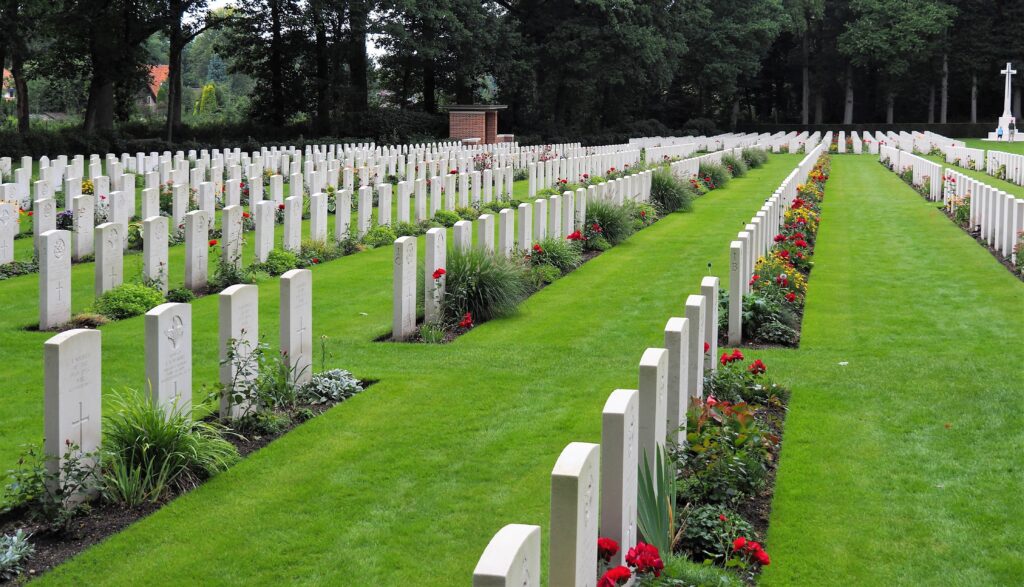
History reveals that from the Classical Roman days until the nineteenth century in western Europe there was a practice of putting flowers on the graves of the fallen. What we call Memorial Day in America was initially called “Decoration Day” during the Civil War times. In the final years of the Civil War, people from the South and the North and both white and black decorated graves with flowers. One of the earliest reports was in Boalsburg, Pennsylvania where three women decorated Civil War graves in October of 1864, while the war was ongoing.
Strewing flowers on the graves of Civil War soldiers’ as a regular practice can be traced to Columbus, Georgia where a Ladies Memorial Association sought to care for their cemetery which was in disarray. Their mission was “to set apart a certain day to be observed … and be handed down through time as a religious custom of the country, to wreathe the graves of our martyred dead with flowers.” These Georgia ladies chose April 26, 1866 as the day to decorate and remember. The city of Columbus, Mississippi, however, held a similar event one day before the Decoration Day the ladies of Columbus, Georgia chose, and thus claimed to be the first to celebrate this memorial event honoring both Confederate and Union soldiers. They each saw Decoration Day as a way of reconciliation for our nation honoring all who fought for the cause they believed in during the Civil War.
After a visiting a Confederate cemetery in Virginia in 1868, Mrs. John Logan told her husband, Major General John A. Logan, about the Southern tradition of Decoration Day. His response was that it was “not too late for the Union men of the nation to follow the example of the people of the South in perpetuating the memory of their friends who had died for the cause which they thought just.” As a result, Logan issued General Orders No. 11 which was called the “Memorial Day Act” to mourn and honor the deceased Civil War fighters.
After WW 1, Memorial Day expanded to include all who died in American wars. During the first World War a poem titled, “In Flanders Fields,” written by a surgeon from Canada named John McCrae told of the abundant poppies in Flanders field on the western coast of Belgium covering the many graves of the fallen. From the publication of that poem in 1915, Moian Michael of Georgia and Anna Guerin of France started a mission on Memorial Day to sell artificial flowers to raise money for the orphans of the soldiers killed in action and to help those left destitute by the loss of their loved ones in World War I. “The Remembrance Poppy,” was officially adopted in 1921 as a national symbol of remembrance for veterans of war. In 1922, the Veterans of Foreign Wars joined Mrs. Michael in her mission and adopted the red poppy as the official flower of remembrance. Due to a shortage of real poppy flowers, a factory employing military veterans in Pittsburg, Pennsylvania produced the artificial poppy flowers that many service and veteran organizations sold on Memorial Day to raise money for orphans and others in need who had lost loved ones in the war.
As a young girl, I remember people standing on street corners on Memorial Days with poppies and collecting money in tin cans from people in their cars at the intersections. It seemed that most dropped coins into the cans, and even the smallest gifts were appreciated and the donors were given a “remembrance poppy.” Even though I didn’t really understand Memorial Day as a child, I saw the solemness with which people received, treasured, and saved the poppies. Once I started driving myself, I too put coins in the can for the orphans and gladly received a red poppy of remebrance.
As a young adult, I remember my husband’s grandmother and their family going to their church cemetery in May to “decorate” the graves with flowers for those buried there who died in war. My husband’s uncle Cleo (his grandmother’s son) died at the Battle of the Bulge during World War II. The flag that covered his casket is a cherished legacy in our home, and the Congressional medals and commendations remain in the family as a testimony to his service and sacrifice for our freedom. I can’t imagine how grandma must have felt to learn that her son had died in World War II.
In order to create some uniformity to the various federal holidays and give a three day weekend to federal employees, Congress passed the the Uniform Monday Holiday Act in 1971, making Memorial Day always on the last Monday in May.
Today Memorial Day is to be observed “by praying, according to their individual religious faith, for permanent peace.” In December of 2000, Congress passed and Act asking that all Americans stop at 3 PM local time to pause to honor the fallen for a minute of silence. I wonder how many people even know about this tradition now 26 years later.
As we celebrate and honor those who gave their lives for freedom and in service to our nation on this Memorial Day (May 25, 2026), let’s remember that freedom is not free. Let’s appreciate the blessings of liberty that we have in this nation. Let us remember those who put their lives, fortunes, and families on the line to establish, defend, and keep this United States of America a place where “We the people” govern ourselves, respect one another’s rights – including freedom of speech, the right to freely assemble, the right to worship God, the right to protect and defend one’s family, and the right to pursue happiness and self-determination.
In visiting over a dozen foreign countries, I have never seen a nation with the bounty, opportunity, and freedoms we have in the United States of America. Each time I return to the United States, I thank God that I am a citizen of this great nation. We are truly blessed in this nation by the sacrifices of our forefathers and mothers. I thank God that I have the opportunity to live in this wonderfully unique nation of people from every tribe and nation on this earth. I hope you do too. I hope in this 250th anniversary year of our nation that we will once again be united as a nation and take pride in our nation and its accomplishments.
Patriotism is said to be a devoted love for one’s country, culture, and fellow citizens. I hope this bit of history stirs your patriotic spirit and helps give more meaning for you to this special Memorial Day. We are still one nation, under God, indivisible, with liberty and justice for all because of the valiant patriots who gave their all for us. This next Memorial Day Monday, let’s think about these things and remember — remember and honor those who gave the ultimate sacrifices of their very lives.
Lastly, let’s remember the ultimate sacrifice of our Savior, Jesus Christ. In John 15:13 Jesus said, “Greater love has no one than this, that someone lay down his life for his friends.” Jesus laid down His life for each one of us while we were still sinners, and He offers us a rich life here on earth and an eternal life with Him in Heaven when we come and follow Him. For those that do follow Christ, God calls us to a memorial as well. God knows that we are a fickle and forgetful people, so He instituted a memorial service called communion for us to remember Jesus’ death, burial, and resurrection. In I Corinthians 11:23-26 Paul says that as often as we take and eat unleavened bread and drink the fruit of the vine, we proclaim the Lord’s death until He comes back again. That is something to remember on Sunday! That is something to celebrate and give us hope. That is one more thing for which we can be grateful and thankful.
May God bless you.
Robin House